
Seven hours between flights sounds generous until the airline takes its share first. International check-in at Terminal E wants passengers three hours ahead of departure, and bag drop closes earlier still.
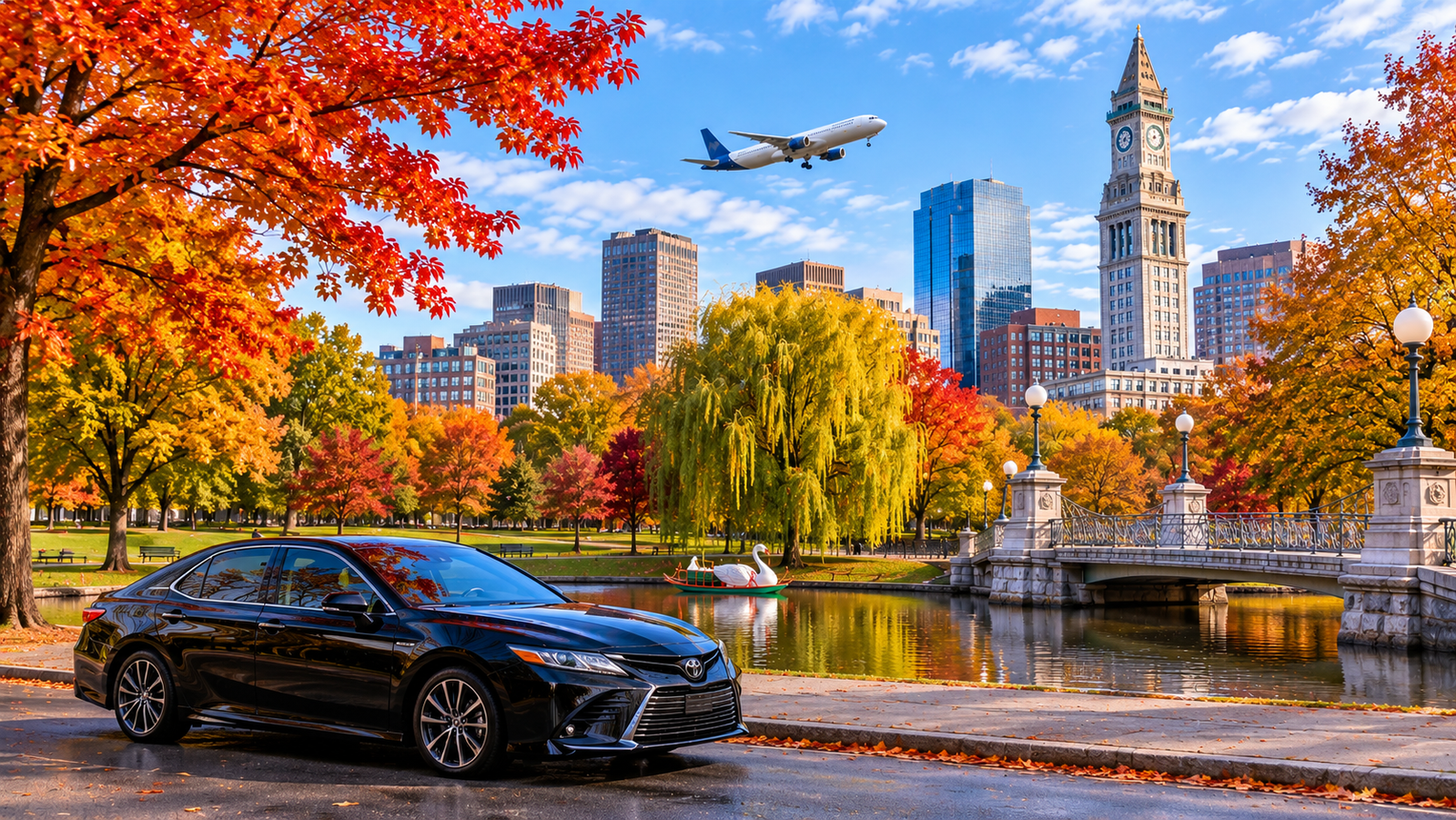
Two miles of harbor separate that terminal from Boston Common, and the crossing runs twenty to thirty-five minutes depending on the hour, which leaves about two and a half hours on the ground. Most of the year that window is barely worth using. Between late October and the middle of November it overlaps the one stretch when the city’s own parks hold color longer than the countryside north of it, and that overlap is what makes the subtraction worth doing.
Subtracting Hours That Are Not Yours
Run the arithmetic honestly before deciding anything. Airlines flying east out of Terminal E want passengers checked in three hours ahead, and bag drop closes earlier than boarding. Travel time from the terminals to Boston Common runs twenty to thirty-five minutes depending on the hour and the route, since everything crosses the harbor through the Ted Williams Tunnel or rides under it.
Public transport is cheap and occasionally slow. Silver Line SL1 buses carry passengers from every terminal to South Station free of charge inbound, and the Blue Line reaches Airport Station by free shuttle. Outbound, both cost money and both lose time at shift change. Travelers with a hard check-in deadline and two cases often book a Boston chauffeur driven car service for the return leg alone, which is the half of the trip where delay actually costs something. Firms including Blue Nile Livery work the Logan runs daily and watch terminal queues instead of the clock on the wall.
Why Autumn Widens The Usable Window
Boston’s color arrives late. Northern New England peaks in early and middle October, while the city’s own canopy holds on until the final week of October and often into the first week of November, which is weeks after the leaf-peeping traffic has gone home. Downtown parks, sheltered by buildings and warmed by pavement, are the last to turn.
Geography does the rest of the work. Boston Common was set aside in 1634 and covers fifty acres, and the Public Garden across Charles Street was established in 1837 as the first public botanical garden in America, with twenty-four acres of lagoon, willows and formal beds. Walking both takes forty minutes. Both are free, open daily, and roughly a mile from the Freedom Trail’s starting point at the visitor center on Tremont Street.
Three Routes That Fit Different Clocks
Pick the route that matches the time you actually have, not the time printed on the ticket.
- With two hours free, walk the Public Garden and Boston Common only, entering from Charles Street, with coffee on Beacon Hill and nothing else attempted.
- With three hours, add the first third of the Freedom Trail, which runs 2.5 miles past sixteen historic sites and can be joined or abandoned anywhere along the red brick line.
- With four hours or more, take the Charles River Esplanade or the Commonwealth Avenue Mall, where the tree-lined blocks hold color later than almost anywhere else in the city, then eat in Back Bay or the North End.
Anything involving the Arnold Arboretum in Jamaica Plain or Mount Auburn Cemetery in Cambridge needs a full five hours. Both are magnificent in autumn and both are too far out for a layover with a plane waiting.
What The Flight East Actually Involves
Knowing the flight helps you judge the ground time. Boston to Amsterdam, one of the most common eastbound routings from Logan, covers about 3,457 miles and runs close to seven hours nonstop with three carriers on the route. Departures cluster in the late afternoon and evening, which is exactly why a long daytime layover happens in the first place.
Amsterdam runs six hours ahead of Boston. Departures at seven in the evening land around nine the following morning, so a full European day begins straight after a short night in a seat. Evening boarding also puts the day’s walking before the flight instead of after it, which is the practical case for leaving the terminal at all.
Where November Weather Costs You Time
Autumn in Boston is unreliable in ways that matter on a tight schedule. Average highs near 52F feel colder in wind off the water, and the sun is down before half past four by the middle of the month. Plans made at noon can lose their point by late afternoon, which is the argument for front-loading the walking.
Coastal storms are the real risk. November wind at Logan averages about 12.5 miles an hour, three days of the month typically deliver half an inch of rain or more, and heavy weather slows the tunnel approaches along with everything behind them. Checking the forecast the night before beats any fixed itinerary, because rain here arrives in bands and the plan has to survive one.
Keeping Luggage Out Of The Equation
Bags decide whether any of this works. Logan has no general left-luggage counter, museums will not hold suitcases, and dragging cases around the Common in the rain is a miserable way to spend a free afternoon. Options follow, in order of how well they hold up.
- Check your bags straight through to the final destination at the first airport, which is usually possible on a single ticket and removes the problem completely.
- Keep a driver with the luggage between stops, so the vehicle takes the role that airport lockers used to fill.
- Leave the bags with a hotel bell desk if the layover includes a booked room, which many eastbound travelers arrange deliberately.
- Carry only a daypack, since a nine o’clock arrival in Europe leaves a full first day for Amsterdam away from the crowds and nowhere to drop a case before check-in.
Footing deserves a thought as well. Brick pavements on Beacon Hill and around Faneuil Hall are uneven, November brings rain on roughly eleven days of the month, and wet leaves on brick are the reason flat shoes with grip beat anything smooth.
Deciding Before You Leave The Terminal
Set one rule and hold it. Pick the time you must be back inside Terminal E, write it down, and treat everything before it as optional. Daylight is the quiet pressure here, since Boston averages close to ten hours of it in November and drops to about nine hours twenty minutes by the end of the month.
Season is what makes the arithmetic worth running. Boston averages a November high near 52F and a low near 38F, with about 3.9 inches of rain spread over eleven days, so late October and early November are the edge of comfortable walking weather and December is past it. Booking the return leg in advance, whether through Blue Nile Livery or another Logan operator with live flight tracking, is what turns a workable plan into a safe one. Boston gives the long layover more to work with than most American hubs, provided the clock stays in charge of it.